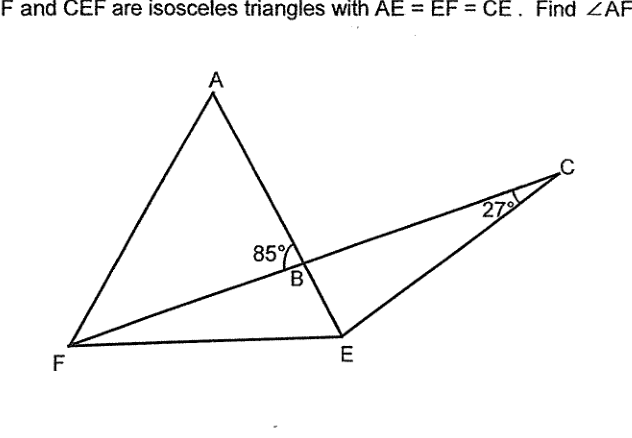
AEF and CEF are isosceles triangles with AE = EF = CE. Find .
It won't just hand you the answer — it asks where you're stuck.How the checker works
Worked solution
9
1. Find $\angle\text{EFC}$ using the isosceles triangle CEF.
In , since , it is an isosceles triangle.
.
Since are collinear, .
2. Find $\angle\text{FEB}$ using the exterior angle of $\triangle EFB$.
In , the exterior angle at is .
.
Since are collinear, .
3. Find $\angle\text{AFE}$ using the isosceles triangle AEF.
In , since , it is an isosceles triangle.
.
4. Calculate $\angle\text{AFB}$.
Since lies on and , the ray is between and .
.
Answer
AI analysis — may contain mistakes.
Worked this one out on paper? Snap your steps and Gigle's AI math checker will circle the step where it went wrong.
More questions on this topic
- 1The net drawn for the solid shown below is incorrect. Name the solid. Ans: (a)___ Shade a triangular face on the net tha…
- 2In the figure below, ABCD is a trapezium and AD = BC. Each of the statements is either true, false or not possible to te…
- 3In the figure, WXYZ is a trapezium and AXYB is a rhombus. XBC and XAZ are straight lines. WX // ZY, BC = BY, …
- 4PQ and QR are two sides of a parallelogram. Complete the drawing of the parallelogram PQRS. QR also forms one side of an…
- 5The figure below is formed by five identical equilateral triangles. The total perimeter of the five triangles is 135 cm.…