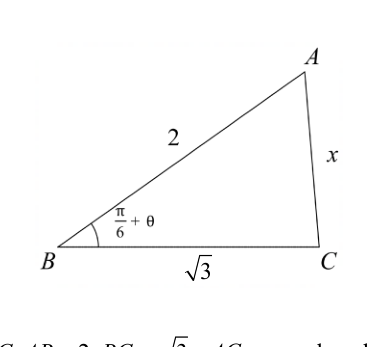
In the triangle ABCABC, AB=2AB = 2, BC=3BC = \sqrt{3}, AC=xAC = x and angle ABC=π6+θABC = \frac{\pi}{6} + \theta radians (see diagram).

  1. (a)

    Show that x2=7−6cos⁡θ+23sin⁡θx^{2} = 7 - 6\cos\theta + 2\sqrt{3}\sin\theta.

  2. (b)

    Show that xd2xdθ2+(dxdθ)2=3cos⁡θ−3sin⁡θx\frac{d^{2}x}{d\theta^{2}} + \left(\frac{dx}{d\theta}\right)^{2} = 3\cos\theta - \sqrt{3}\sin\theta.

  3. (c)

    Use the result from part (b) to find the Maclaurin expansion for xx, up to and including the term in θ3\theta^{3}. Give the coefficients as exact values in their simplest form.

  4. (d)

    Using the result from part (c), deduce the approximate value of xx when angle ABCABC is 35∘35^\circ, giving your answer correct to 6 decimal places.

Work through it with AI →

It won't just hand you the answer — it asks where you're stuck.How the checker works

Worked solution

5(a)

1. Apply the cosine rule to triangle $ABC$ to find an initial expression for $x^2$.

x2=AB2+BC2−2(AB)(BC)cos⁡(∠ABC)x^2 = AB^2 + BC^2 - 2(AB)(BC)\cos(\angle ABC)
x2=22+(3)2−2(2)(3)cos⁡(π6+θ)x^2 = 2^2 + (\sqrt{3})^2 - 2(2)(\sqrt{3})\cos\left(\frac{\pi}{6} + \theta\right)
x2=4+3−43cos⁡(π6+θ)x^2 = 4 + 3 - 4\sqrt{3}\cos\left(\frac{\pi}{6} + \theta\right)
x2=7−43cos⁡(π6+θ)x^2 = 7 - 4\sqrt{3}\cos\left(\frac{\pi}{6} + \theta\right)

2. Expand the trigonometric expression using the addition formula and simplify to the target form.

Using the addition formula cos⁡(A+B)=cos⁡Acos⁡B−sin⁡Asin⁡B\cos(A + B) = \cos A \cos B - \sin A \sin B:
x2=7−43(cos⁡π6cos⁡θ−sin⁡π6sin⁡θ)x^2 = 7 - 4\sqrt{3}\left(\cos\frac{\pi}{6}\cos\theta - \sin\frac{\pi}{6}\sin\theta\right)
Substituting the exact trigonometric ratios cos⁡π6=32\cos\frac{\pi}{6} = \frac{\sqrt{3}}{2} and sin⁡π6=12\sin\frac{\pi}{6} = \frac{1}{2}:
x2=7−43(32cos⁡θ−12sin⁡θ)x^2 = 7 - 4\sqrt{3}\left(\frac{\sqrt{3}}{2}\cos\theta - \frac{1}{2}\sin\theta\right)
x2=7−43(32)cos⁡θ+43(12)sin⁡θx^2 = 7 - 4\sqrt{3}\left(\frac{\sqrt{3}}{2}\right)\cos\theta + 4\sqrt{3}\left(\frac{1}{2}\right)\sin\theta
x2=7−6cos⁡θ+23sin⁡θx^2 = 7 - 6\cos\theta + 2\sqrt{3}\sin\theta

Answer

x2=7−6cos⁡θ+23sin⁡θx^2 = 7 - 6\cos\theta + 2\sqrt{3}\sin\theta

5(c)

1. Find the values of $x$ and its first derivative at $\theta = 0$.

From part (a), x2=7−6cos⁡θ+23sin⁡θx^{2} = 7 - 6\cos\theta + 2\sqrt{3}\sin\theta.
At θ=0\theta = 0:
x(0)2=7−6(1)+0=1x(0)^2 = 7 - 6(1) + 0 = 1
Since xx is a side length of a triangle, x>0x > 0, so x(0)=1x(0) = 1.

Differentiating implicitly with respect to θ\theta:
2xdxdθ=6sin⁡θ+23cos⁡θ2x \frac{dx}{d\theta} = 6\sin\theta + 2\sqrt{3}\cos\theta
Substitute θ=0\theta = 0 and x(0)=1x(0) = 1:
2(1)dxdθ=6(0)+23(1)  ⟹  dxdθ∣θ=0=32(1) \frac{dx}{d\theta} = 6(0) + 2\sqrt{3}(1) \implies \frac{dx}{d\theta}\bigg|_{\theta=0} = \sqrt{3}

2. Use the equation from part (b) to evaluate the second derivative at $\theta = 0$.

From part (b):
xd2xdθ2+(dxdθ)2=3cos⁡θ−3sin⁡θx\frac{d^{2}x}{d\theta^{2}} + \left(\frac{dx}{d\theta}\right)^{2} = 3\cos\theta - \sqrt{3}\sin\theta
Substitute θ=0\theta = 0, x(0)=1x(0) = 1, and dxdθ∣θ=0=3\frac{dx}{d\theta}\Big|_{\theta=0} = \sqrt{3}:
1⋅d2xdθ2∣θ=0+(3)2=3(1)−01 \cdot \frac{d^{2}x}{d\theta^{2}}\bigg|_{\theta=0} + (\sqrt{3})^2 = 3(1) - 0
d2xdθ2∣θ=0+3=3  ⟹  d2xdθ2∣θ=0=0\frac{d^{2}x}{d\theta^{2}}\bigg|_{\theta=0} + 3 = 3 \implies \frac{d^{2}x}{d\theta^{2}}\bigg|_{\theta=0} = 0

3. Differentiate the equation from part (b) to find the third derivative at $\theta = 0$.

Differentiate the equation from part (b) implicitly with respect to θ\theta:
dxdθd2xdθ2+xd3xdθ3+2(dxdθ)d2xdθ2=−3sin⁡θ−3cos⁡θ\frac{dx}{d\theta}\frac{d^{2}x}{d\theta^{2}} + x\frac{d^{3}x}{d\theta^{3}} + 2\left(\frac{dx}{d\theta}\right)\frac{d^{2}x}{d\theta^{2}} = -3\sin\theta - \sqrt{3}\cos\theta
xd3xdθ3+3dxdθd2xdθ2=−3sin⁡θ−3cos⁡θx\frac{d^{3}x}{d\theta^{3}} + 3\frac{dx}{d\theta}\frac{d^{2}x}{d\theta^{2}} = -3\sin\theta - \sqrt{3}\cos\theta
Substitute θ=0\theta = 0, along with our known evaluated derivatives:
1⋅d3xdθ3∣θ=0+3(3)(0)=−3(0)−3(1)1 \cdot \frac{d^{3}x}{d\theta^{3}}\bigg|_{\theta=0} + 3(\sqrt{3})(0) = -3(0) - \sqrt{3}(1)
d3xdθ3∣θ=0=−3\frac{d^{3}x}{d\theta^{3}}\bigg|_{\theta=0} = -\sqrt{3}

4. Substitute the evaluated derivatives into the Maclaurin series formula.

The Maclaurin expansion for xx is:
x(θ)=x(0)+x′(0)θ+x′′(0)2!θ2+x′′′(0)3!θ3+…x(\theta) = x(0) + x'(0)\theta + \frac{x''(0)}{2!}\theta^2 + \frac{x'''(0)}{3!}\theta^3 + \dots
Substituting the evaluated constants:
x(θ)=1+3θ+02θ2+−36θ3x(\theta) = 1 + \sqrt{3}\theta + \frac{0}{2}\theta^2 + \frac{-\sqrt{3}}{6}\theta^3
x(θ)=1+3θ−36θ3x(\theta) = 1 + \sqrt{3}\theta - \frac{\sqrt{3}}{6}\theta^3

Answer

1+3θ−36θ31 + \sqrt{3}\theta - \frac{\sqrt{3}}{6}\theta^3

5(d)

1. Derive the Maclaurin expansion for $x$ up to the term in $\theta^3$ as required from part (c).

From part (a), at θ=0\theta = 0, x2=7−6(1)+0=1  ⟹  x=1x^2 = 7 - 6(1) + 0 = 1 \implies x = 1 (since length x>0x > 0).

Differentiating the equation from (a) with respect to θ\theta:
2xdxdθ=6sin⁡θ+23cos⁡θ2x\frac{dx}{d\theta} = 6\sin\theta + 2\sqrt{3}\cos\theta
At θ=0\theta = 0: 2(1)dxdθ=23  ⟹  dxdθ=32(1)\frac{dx}{d\theta} = 2\sqrt{3} \implies \frac{dx}{d\theta} = \sqrt{3}.

Using the given equation from (b) at θ=0\theta = 0:
(1)d2xdθ2+(3)2=3(1)−0  ⟹  d2xdθ2=0(1)\frac{d^2x}{d\theta^2} + (\sqrt{3})^2 = 3(1) - 0 \implies \frac{d^2x}{d\theta^2} = 0

Differentiating the equation from (b) with respect to θ\theta using the Product and Chain rules:
xd3xdθ3+dxdθd2xdθ2+2dxdθd2xdθ2=−3sin⁡θ−3cos⁡θx\frac{d^3x}{d\theta^3} + \frac{dx}{d\theta}\frac{d^2x}{d\theta^2} + 2\frac{dx}{d\theta}\frac{d^2x}{d\theta^2} = -3\sin\theta - \sqrt{3}\cos\theta
At θ=0\theta = 0:
(1)d3xdθ3+3(3)(0)=−3  ⟹  d3xdθ3=−3(1)\frac{d^3x}{d\theta^3} + 3(\sqrt{3})(0) = -\sqrt{3} \implies \frac{d^3x}{d\theta^3} = -\sqrt{3}

Substituting these derivatives into the Maclaurin series formula:
x≈1+(3)θ+02!θ2+−33!θ3x \approx 1 + (\sqrt{3})\theta + \frac{0}{2!}\theta^2 + \frac{-\sqrt{3}}{3!}\theta^3
x≈1+3θ−36θ3x \approx 1 + \sqrt{3}\theta - \frac{\sqrt{3}}{6}\theta^3

2. Determine the value of $\theta$ in radians corresponding to angle $ABC = 35^\circ$.

We are given that angle ABC=π6+θABC = \frac{\pi}{6} + \theta.
Since π6\frac{\pi}{6} radians is equivalent to 30∘30^\circ, when the angle is 35∘35^\circ, we have:
30∘+θ∘=35∘  ⟹  θ∘=5∘30^\circ + \theta^\circ = 35^\circ \implies \theta^\circ = 5^\circ
To use the Maclaurin expansion, the angle θ\theta must be in radians:
θ=5∘×π180∘=π36 radians\theta = 5^\circ \times \frac{\pi}{180^\circ} = \frac{\pi}{36} \text{ radians}

3. Substitute $\theta = \frac{\pi}{36}$ into the Maclaurin expansion to approximate $x$.

Substitute θ=π36\theta = \frac{\pi}{36} into the Maclaurin expansion obtained from part (c):
x≈1+3(π36)−36(π36)3x \approx 1 + \sqrt{3}\left(\frac{\pi}{36}\right) - \frac{\sqrt{3}}{6}\left(\frac{\pi}{36}\right)^3
Using a calculator to compute the value:
x≈1+0.15115002−0.00019185x \approx 1 + 0.15115002 - 0.00019185
x≈1.15095817x \approx 1.15095817
Rounding the result to 6 decimal places, we get:
x≈1.150958x \approx 1.150958

Answer

1.150958

AI analysis — may contain mistakes.

Worked this one out on paper? Snap your steps and Gigle's AI math checker will circle the step where it went wrong.

More questions on this topic

  1. 1The curve C has equation x+y=(x−y)2x + y = (x - y)^2. It is given that C has only one turning point. Show that 1−dydx=21+2x−2y1 - \frac{dy}{dx} = \frac{2}{1 + 2x - 2y}…
  2. 2The curve C has equation x+y=(x−y)2.x + y = (x - y)^2. It is given that C has only one turning point. Show that 1−dydx=21+2x−2y1 - \dfrac{dy}{dx} = \dfrac{2}{1 + 2x - 2y}…
  3. 3A curve C1C_1 has the equation p2x2−y2=p2p^2x^2 - y^2 = p^2 where p>1p > 1. Sketch C1C_1, stating the coordinates of any points o…
  4. 4A curve CC has parametric equations x=2cos⁡θ+cos⁡2θ,y=2sin⁡θ−sin⁡2θ,x = 2\cos\theta + \cos 2\theta, \quad y = 2\sin\theta - \sin 2\theta, where 0<θ<2π0 < \theta < 2\pi…
  5. 5It is given that y=1+tan⁡−12xy = \sqrt{1 + \tan^{-1} 2x} where −12<x<12-\frac{1}{2} < x < \frac{1}{2}. Show that yd2ydx2+(dydx)2+8x(1+4x2)2=0.y \frac{\mathrm{d}^2 y}{\mathrm{d}x^2} + \left(\frac{\mathrm{d}y}{\mathrm{d}x}\right)^2 + \frac{8x}{(1 + 4x^2)^2} = 0.…