A company sells chocolate muffins and banana muffins. These muffins are sold across three different outlets, which are Outlet A, Outlet B and Outlet C. The table shows the number of boxes of chocolate muffins and banana muffins produced at each of the three outlets in a particular day. The table can be represented by matrix Q, where
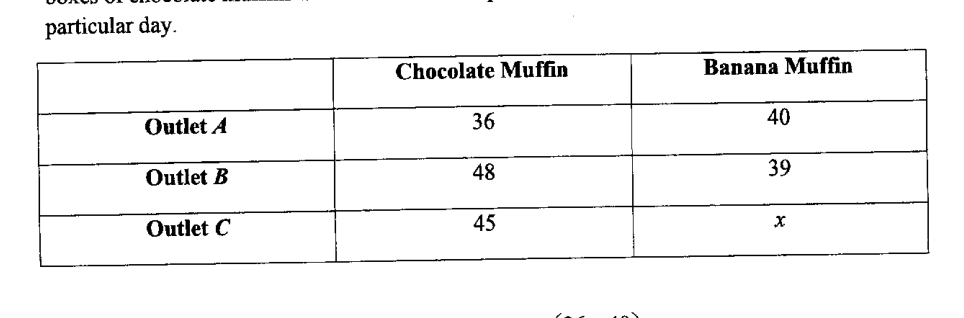
- (a)
- (i)
The production cost for each box of chocolate muffin and each box of banana muffin is $3 and $4.50 respectively. Represent this information in a 2×1 matrix, P.
Answer P =
- (ii)
Evaluate the matrix R = QP.
Answer R =
- (i)
- (b)
State what each of the elements in matrix R represents.
- (c)
The company sells each box of muffins for 70% more than it costs to produce.
On that day, the company sold 5/6 of each flavour of muffins in Outlet A, 4/5 of each flavour of muffins in Outlet B, and all the muffins in Outlet C.
By using the matrix R, find the total amount collected from the sale of muffins from all three outlets.
Answer $ ...
- (d)
The total amount collected from the sales of muffins from all three outlets is $1454.52. Calculate the value of x.
Answer x = ...
It won't just hand you the answer — it asks where you're stuck.How the checker works
Worked solution
20(a)(i)
1. Write the two production costs as a $2\times 1$ column matrix in the correct order.
The columns of are in the order: Chocolate Muffin, Banana Muffin.
So the cost matrix is
20(a)(ii)
1. Carry out row-by-column multiplication to find each element of $R=QP$.
20(b)
1. Identify what the matrix multiplication $QP$ calculates.
Matrix gives the number of boxes of each flavour produced at each outlet, and matrix gives the production cost per box of each flavour.
Thus each element of is:
2. State the contextual meaning of the elements of $R$.
Since the rows of correspond to Outlet A, Outlet B and Outlet C, the elements of represent the total production costs for Outlet A, Outlet B and Outlet C respectively.
Each element in represents the total production cost, in dollars, of the muffins produced at the corresponding outlet.
So the elements represent the total production costs for Outlet A, Outlet B and Outlet C respectively.
20(c)
1. Convert the selling price condition into a multiplier.
Selling price is more than production cost.
2. Use the entries of $R$ with the fractions sold to find the production cost of the muffins sold at each outlet.
From part (a)(ii),
Production cost of muffins sold:
Outlet A:
Outlet B:
Outlet C:
3. Multiply the total production cost of muffins sold by $1.7$ and add to get the total amount collected.
Total amount collected:
$$(1072.02+7.65x)\text{ dollars}$$
20(d)
1. Form and solve the linear equation using the total amount collected.
From part (c), the total amount collected is
Given that this is $1454.52,
AI analysis — may contain mistakes.
Worked this one out on paper? Snap your steps and Gigle's AI math checker will circle the step where it went wrong.
More questions on this topic
- 1On every weekday, a bakery delivers chicken pies and apple pies to four cafes. On every weekend, it delivers double the…
- 2A tour agency sells cruise packages to Vietnam, Maldives and Taiwan at $1299, $1398 and $2538 respectively. The table…
- 3Given that …
- 4A theatre sells tickets for a musical performance based on different categories. The table below shows the number of tic…
- 5A cake shop sells 3 types of cakes. On Day 1, the shop sold 84 chocolate cakes, 90 vanilla cakes and 56 strawberry cakes…