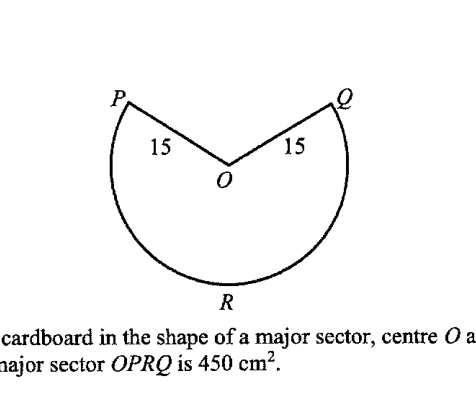
The diagram shows a cardboard in the shape of a major sector, centre O and radius 15 cm. The total area of the major sector OPRQ is 450 cm².
- (a)
Calculate reflex angle POQ in radians.
Answer ... radians
- (b)
Calculate the perimeter of the cardboard.
Answer ... cm
- (c)
OP and OQ is joined together such that the cardboard forms a conical party hat.
- (i)
Find the height of the hat.
Answer ... cm
- (ii)
Calculate the volume of the cone.
Answer ... cm^3
- (i)
It won't just hand you the answer — it asks where you're stuck.How the checker works
Worked solution
7(a)
1. Substitute the given area and radius into the sector area formula.
For a sector, Given and ,
2. Solve for the reflex angle $\theta$.
radians
7(b)
1. Find the length of the major arc using $s=r\theta$.
Since the reflex angle is radians and the radius is cm,
2. Add the two radii to the major arc length to get the perimeter.
7(c)(i)
1. Find the radius of the cone's base from the arc length of the sector.
From earlier parts, the length of the major arc is . This becomes the circumference of the base of the cone.
2. Use the slant height and base radius to form a right-angled triangle equation.
The radius of the sector, , becomes the slant height of the cone.
Using Pythagoras' theorem,
3. Solve for the vertical height of the cone.
7(c)(ii)
1. Substitute the cone radius and height into the cone volume formula.
From earlier parts, the base radius is and the height is
.
2. Evaluate the volume and round suitably.
To significant figures,
AI analysis — may contain mistakes.
Worked this one out on paper? Snap your steps and Gigle's AI math checker will circle the step where it went wrong.
More questions on this topic
- 1A piece of wood which was 50 cm long, was in the shape of a uniform cylinder. A prism is cut out from the wood such that…
- 2In the diagram, POR is a quadrant of a circle with radius 6 cm. OR and PQ are parallel. QR is an arc of a circle with ce…
- 3A circle with centre O has a tangent XY at D. ∠ODC = 70°, ∠BCD = 120° and ∠ODA = 15°. Find ∠CDY. Find ∠DAB. Find ∠OBA. T…
- 4In the diagram, BA and BC are tangents to the circle with centre O. BO meets the circle at D, OA = 10 cm and BC = 28 cm.…
- 5The diagram shows a circle PQRST, with centre O. PV and RV are tangents to the circle and U is the intersection of PS an…