Twelve students from three CCAs organised an overseas learning trip to Shanghai. It comprises five students from Tennis, four students from Bowling and three students from Softball. The available seats for the flight for them to choose from are shown on the diagram as follows:
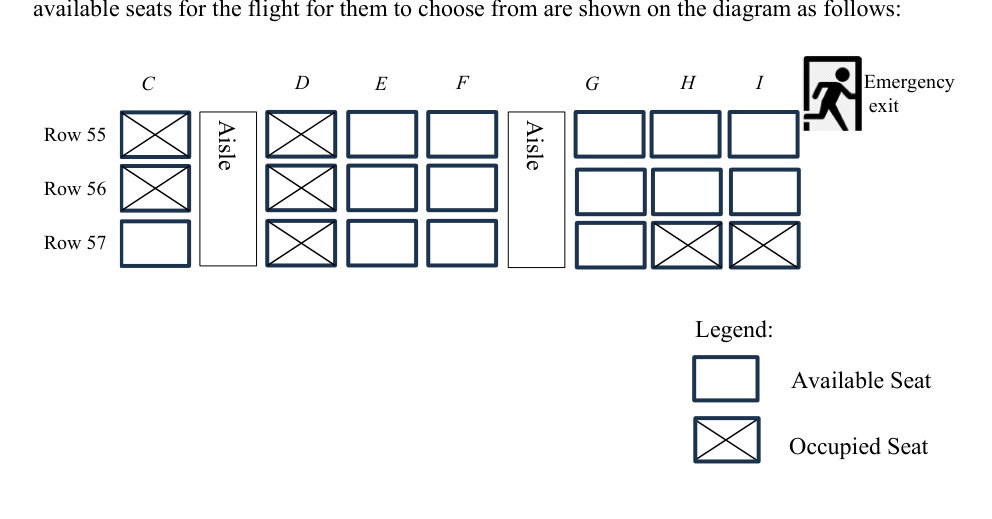
- (a)
In how many different ways can the students be seated if there is a particular student who must be seated nearest to the emergency exit?
- (b)
Find the number of ways they can be seated if two particular students do not want to be seated on any of the aisle seats.
- (c)
Find the number of ways they can be seated if students of the same CCA must be seated together either front and back or left and right, and cannot be separated by an aisle. For example, the three students from Softball can be seated at Row 56 Seat G, H and Row 57 Seat G, but not Row 56 Seat H, I and Row 57 Seat G.
It won't just hand you the answer — it asks where you're stuck.How the checker works
Worked solution
7(a)
1. Assign the particular student to the fixed seat
The particular student is assigned to the fixed seat nearest to the emergency exit (Row 55 Seat I). There is way to do this, leaving students and available seats.
2. Arrange the remaining students in the remaining seats
The remaining students can be arranged in the remaining available seats in ways.
7(b)
1. Identify the available non-aisle seats
Aisle seats are columns C, D, F, G. The non‑aisle seats lie in columns E, H, I. The available (un‑crossed) non‑aisle seats are:
This gives non‑aisle seats available for the two restricted students.
2. Seat the two restricted students first
The two particular students must take of the non‑aisle seats, and order matters (different students in different seats):
3. Seat the remaining students and combine
After seating the two students, seats remain for the other students:
By the multiplication principle:
ways
AI analysis — may contain mistakes.
Worked this one out on paper? Snap your steps and Gigle's AI math checker will circle the step where it went wrong.
More questions on this topic
- 1Eight students are shortlisted to be prize recipients for a competition. Two students are awarded the first prize and an…
- 2A personality test assesses 32 key traits. These 32 traits are grouped into 4 domains - Cognition, Influence, Rapport an…
- 3An amateur music composer is arranging a sequence of four musical notes followed by three beats. There are 7 possible no…
- 4Two brothers Kai and Leo are duathlon (running and cycling) athletes who train regularly. For each day, the probability…
- 5Colour Vision Deficiency is the decreased ability to see differences in colours. Someone with normal colour vision will…