By the end of 2022, the percentages of a population who has received V dose(s) of Covid-19 vaccine are shown in the table below, with no one receiving 5 or more doses of vaccine. Mr Lee is doing a survey on people's perspectives on the Covid-19 vaccine. [Continued] Assume now that these assumptions do in fact hold.
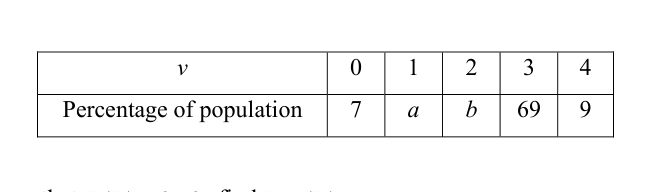
- (a)
Given that , find .
- (b)
Find the probability that the total number of doses of vaccine received by 3 randomly selected surveyees is more than 10.
- (c)
Moderna's and Pfizer-BioNTech's bivalent vaccine are available at a particular vaccination centre.
On average 60% of walk-ins opt for Moderna's bivalent vaccine at this centre. Let denote the number of people, out of walk-ins surveyed by Mr Lee on a particular day, that choose to receive the Moderna's bivalent vaccine.
Explain, in the context of this question, the assumptions needed to model by a binomial distribution.
- (d)
Find when .
- (e)
Find the least number of people Mr Lee needs to survey to have at least a 90% chance of at least 15 surveyees choosing to receive Moderna's bivalent vaccine.
It won't just hand you the answer — it asks where you're stuck.How the checker works
Worked solution
11(a)
1. Formulate an equation using the fact that the sum of probabilities is 1.
Let be the probability that a person receives doses.
2. Formulate a second equation using the given expectation.
3. Solve the simultaneous equations to find $a$ and $b$.
Subtracting equation (1) from equation (2):
Substitute into equation (1):
Thus, and .
4. Calculate the variance of $V$.
11(b)
1. Identify the possible sum combinations for 3 people to have more than 10 doses in total.
Let be the total number of doses received by 3 people. Since the maximum number of doses per person is , the only possible totals greater than are and .
For , the only possible combination is .
For , the possible combinations are , , and .
2. Calculate the probability for each of the valid totals using the independent probabilities from the table.
From the table, and .
3. Add the probabilities of these mutually exclusive cases to find the final probability.
(or to 3 s.f.)
11(c)
1. State the assumption of independence in the context of the problem.
Whether a walk-in opts for Moderna's bivalent vaccine is independent of the choice made by any other walk-in.
2. State the assumption of constant probability in the context of the problem.
The probability that any walk-in chooses Moderna's bivalent vaccine is a constant at (or ).
- Whether a walk-in chooses Moderna's bivalent vaccine is independent of the choice made by any other walk-in.
- The probability of any walk-in choosing Moderna's bivalent vaccine is a constant .
11(d)
1. Identify the parameters of the binomial distribution and express the required probability interval in terms of inclusive discrete values.
Given that and the probability of a walk-in opting for Moderna's bivalent vaccine is , we have:
Since represents a discrete number of people, the inequality includes the integers and .
2. Evaluate the probability using the binomial cumulative distribution function.
Using a graphing calculator:
11(e)
1. Formulate the inequality for the given probability condition.
We require .
2. Use a graphing calculator to evaluate the probabilities for different values of $n$.
Using a graphing calculator, we check the values of for consecutive integer values of :
When ,
When ,
3. State the least number of people to be surveyed.
Since the condition is first met when , the least number of people Mr Lee needs to survey is .
30
AI analysis — may contain mistakes.
Worked this one out on paper? Snap your steps and Gigle's AI math checker will circle the step where it went wrong.
More questions on this topic
- 1An amateur music composer is arranging a sequence of four musical notes followed by three beats. There are 7 possible no…
- 2Two brothers Kai and Leo are duathlon (running and cycling) athletes who train regularly. For each day, the probability…
- 3Colour Vision Deficiency is the decreased ability to see differences in colours. Someone with normal colour vision will…
- 4A pair of siblings, Abbey and Betty, went to a book fair with six other friends. The eight of them stood in a queue in r…
- 5A particular disease is known to infect approximately 1 in every 10 000 people. A test for this disease is 99.9% accurat…