Kitty has 5 small, 3 medium and 2 large spherical charms and each of the 10 charms is uniquely designed.
- (a)
Kitty arranges all the charms in a circle on a corkboard with charms of the same sizes next to each other. How many ways are there for her to do so?
- (b)
On another occasion, Kitty arranges all the charms in a line at the base of a photo frame with none of the small charms next to each other. How many ways are there for her to do so?
- (c)
The diameters of all the small, medium and large charms are 0.5 cm, 1 cm and 2 cm respectively. Each of the spherical charms has a hole through its centre that allows it to be threaded through a chain.
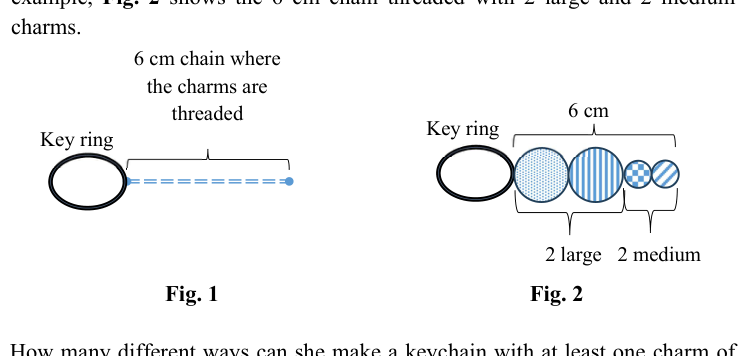
Kitty makes a keychain that includes a 6 cm chain with one end attached to a keyring, as shown in Fig. 1. It is given that the 6 cm chain is fully threaded with charms, with no gaps between them, and is stretched taut in a straight line. For example, Fig. 2 shows the 6 cm chain threaded with 2 large and 2 medium charms.
How many different ways can she make a keychain with at least one charm of each of the three sizes?
It won't just hand you the answer — it asks where you're stuck.How the checker works
Worked solution
6(a)
1. Treat each size group as a single block and arrange the 3 blocks in a circle.
There are 3 groups of charms (small, medium, large).
The number of ways to arrange 3 groups in a circle is .
2. Multiply by the number of arrangements of the unique charms within each group to find the total.
Since each charm is uniquely designed, the charms within each group can be arranged among themselves in , , and ways respectively.
6(b)
1. Find the number of ways to arrange the non-small charms in a line
There are medium and large charms, giving a total of non-small charms. Since all charms are uniquely designed, the number of ways to arrange them in a line is:
2. Place the small charms into the gaps between the non-small charms and calculate the total ways
The non-small charms create available gaps (including the two ends). To ensure no small charms are next to each other, we must place the uniquely designed small charms into these gaps.
Number of ways to slot them in .
Total number of arrangements .
6(c)
1. Formulate the length equation and identify the constraints for the charms.
Let , , and be the number of small, medium, and large charms used respectively.
Given the diameters, the total length is .
The question states Kitty has a maximum of 5 small, 3 medium, and 2 large charms, and she uses at least one of each size.
Therefore, the constraints are , , and .
2. Determine all valid combinations of $(s, m, l)$ that satisfy the constraints.
Substitute the possible values of to find valid pairs:
If :
Checking values for :
- If , (Valid)
- If , (Valid)
- If , (Invalid, since )
If :
Checking values for :
- If , (Valid)
- If , (Invalid, since )
Thus, the valid cases for are , , and .
3. Calculate the number of ways to choose and arrange the charms for each valid case.
Since all charms are uniquely designed, order matters, and the ends of the chain are distinct (one has a keyring), we use permutations for the selected charms.
Case 1: , total charms.
Ways
Case 2: , total charms.
Ways
Case 3: , total charms.
Ways
4. Find the total number of different ways.
Total number of ways
169200
AI analysis — may contain mistakes.
Worked this one out on paper? Snap your steps and Gigle's AI math checker will circle the step where it went wrong.
More questions on this topic
- 1Eight students are shortlisted to be prize recipients for a competition. Two students are awarded the first prize and an…
- 2A personality test assesses 32 key traits. These 32 traits are grouped into 4 domains - Cognition, Influence, Rapport an…
- 3An amateur music composer is arranging a sequence of four musical notes followed by three beats. There are 7 possible no…
- 4Two brothers Kai and Leo are duathlon (running and cycling) athletes who train regularly. For each day, the probability…
- 5Colour Vision Deficiency is the decreased ability to see differences in colours. Someone with normal colour vision will…