A piece of wood which was 50 cm long, was in the shape of a uniform cylinder.
A prism is cut out from the wood such that its cross-section is a minor segment of a circle, with centre , radius cm and radians.
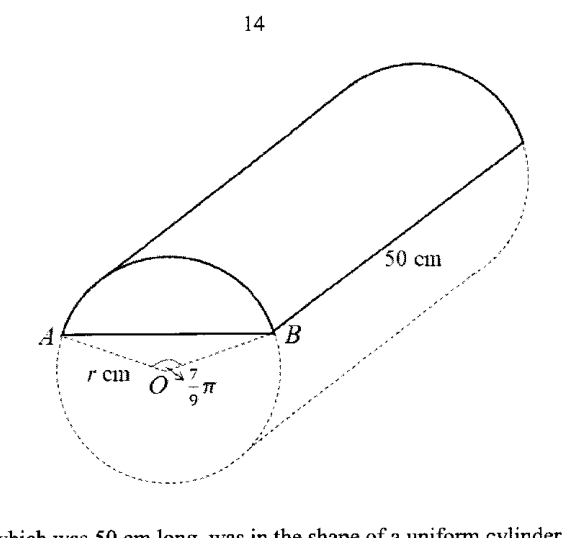
- (a)
Given that the area of the minor segment is , show that , correct to 3 decimal places.
Answer
- (b)
Sally would like to use a roll of 2 m long ribbon to beautify the outline of the prism by using it to paste on all the six edges. Determine if there is sufficient ribbon.
It won't just hand you the answer — it asks where you're stuck.How the checker works
Worked solution
6(a)
1. Convert the given area from square metres to square centimetres to match the units of $r$.
2. Set up the equation for the area of the minor segment.
3. Solve for $r$.
(shown)
6(b)
1. Identify the six edges of the prism and their respective lengths.
The 6 edges consist of:
- 2 straight edges along the length of the prism ( cm each)
- 2 curved edges (minor arcs on both cross-sections)
- 2 straight edges (chords on both cross-sections)
2. Calculate the length of the minor arc $AB$.
Length of one arc cm
3. Calculate the length of the chord $AB$.
Using the cosine rule in :
cm
(Alternatively, cm)
4. Calculate the total length of the edges and conclude.
Total length cm
Since , there is sufficient ribbon.
Total length is cm ( m), which is less than m. Yes, there is sufficient ribbon.
AI analysis — may contain mistakes.
Worked this one out on paper? Snap your steps and Gigle's AI math checker will circle the step where it went wrong.
More questions on this topic
- 1Given that and , find , .
- 2A bird is sitting on the top, , of a vertical pole 20 m above the ground and the angle of elevation of the bird at …
- 3Given that and , where angle and angle are in the same quadrant,…
- 4The diagram shows a chocolate bar in the form of a triangular prism and the cross-section of the chocolate bar is an iso…
- 5The diagram shows two chords AB and CD intersect at X such that angle CXB = . Given that ,…