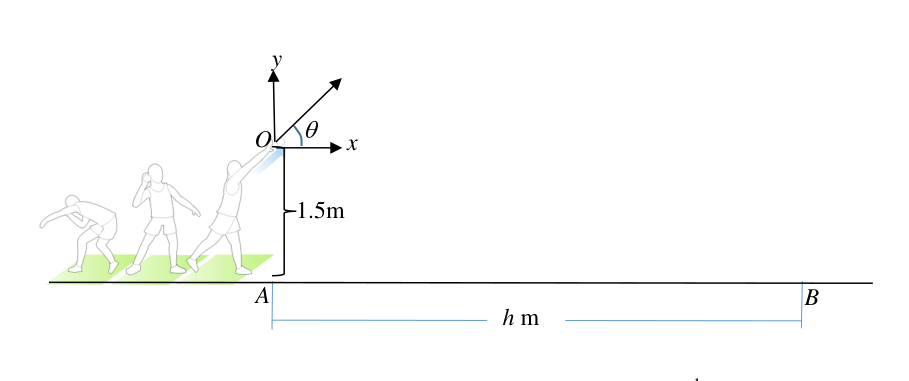
The diagram shows a shot put being projected with a velocity v ms−1v\text{ ms}^{-1} from the point OO at an angle θ\theta made with the horizontal. The point OO is 1.5m1.5\text{m} above the point AA on the ground. The xx-yy plane is taken to be the plane that contains the trajectory of this projectile motion with xx-axis parallel to the horizontal and OO being the origin. The equation of the trajectory of this projectile motion is known to be
y=xtan⁡θ−gx22v2cos⁡2θ,y = x\tan\theta - \frac{gx^2}{2v^2\cos^2\theta},
where g ms−2g\text{ ms}^{-2} is the acceleration due to gravity.
The constant gg is taken to be 1010 and the distance between AA and BB is denoted by h mh\text{ m}.

  1. (a)

    Given that v=10v = 10, show that hh satisfies the equation
    h2−10hsin⁡2θ−15cos⁡2θ−15=0.h^2 - 10h\sin 2\theta - 15\cos 2\theta - 15 = 0.

  2. (b)

    As θ\theta varies, hh varies. Show that stationary value of hh occurs when θ\theta satisfies the following equation
    3tan⁡22θ−20sin⁡2θtan⁡2θ−20cos⁡2θ−20=0.3\tan^2 2\theta - 20\sin 2\theta\tan 2\theta - 20\cos 2\theta - 20 = 0.

  3. (c)

    Hence find the stationary value of hh.

Work through it with AI →

It won't just hand you the answer — it asks where you're stuck.How the checker works

Worked solution

6(a)

1. State the coordinates of the landing point $B$ to substitute into the trajectory equation.

Since OO is 1.5 m1.5\text{ m} above AA and the horizontal distance between AA and BB is h mh\text{ m}, the coordinates of point BB on the xx-yy plane are (h,−1.5)(h, -1.5).

2. Substitute the coordinates of $B$ and the given values into the trajectory equation.

Substitute x=hx = h, y=−1.5y = -1.5, v=10v = 10, and g=10g = 10 into the trajectory equation:
−1.5=htan⁡θ−10h22(10)2cos⁡2θ-1.5 = h\tan\theta - \frac{10h^2}{2(10)^2\cos^2\theta}
−1.5=htan⁡θ−h220cos⁡2θ-1.5 = h\tan\theta - \frac{h^2}{20\cos^2\theta}

3. Rearrange the equation and express $\tan\theta$ in terms of sine and cosine.

Multiply both sides by 20cos⁡2θ20\cos^2\theta:
−30cos⁡2θ=20h(sin⁡θcos⁡θ)cos⁡2θ−h2-30\cos^2\theta = 20h\left(\frac{\sin\theta}{\cos\theta}\right)\cos^2\theta - h^2
−30cos⁡2θ=20hsin⁡θcos⁡θ−h2-30\cos^2\theta = 20h\sin\theta\cos\theta - h^2
h2−20hsin⁡θcos⁡θ−30cos⁡2θ=0h^2 - 20h\sin\theta\cos\theta - 30\cos^2\theta = 0

4. Apply double angle identities to obtain the target equation.

Use the double angle identities 2sin⁡θcos⁡θ=sin⁡2θ2\sin\theta\cos\theta = \sin 2\theta and 2cos⁡2θ=cos⁡2θ+12\cos^2\theta = \cos 2\theta + 1:
h2−10h(2sin⁡θcos⁡θ)−15(2cos⁡2θ)=0h^2 - 10h(2\sin\theta\cos\theta) - 15(2\cos^2\theta) = 0
h2−10hsin⁡2θ−15(cos⁡2θ+1)=0h^2 - 10h\sin 2\theta - 15(\cos 2\theta + 1) = 0
h2−10hsin⁡2θ−15cos⁡2θ−15=0(Shown)h^2 - 10h\sin 2\theta - 15\cos 2\theta - 15 = 0 \quad \text{(Shown)}

Answer

h2−10hsin⁡2θ−15cos⁡2θ−15=0h^2 - 10h\sin 2\theta - 15\cos 2\theta - 15 = 0

6(b)

1. Differentiate the given equation implicitly with respect to $\theta$.

ddθ(h2−10hsin⁡2θ−15cos⁡2θ−15)=0\frac{\mathrm{d}}{\mathrm{d}\theta} (h^2 - 10h\sin 2\theta - 15\cos 2\theta - 15) = 0
2hdhdθ−(10dhdθsin⁡2θ+10h(2cos⁡2θ))−15(−2sin⁡2θ)=02h \frac{\mathrm{d}h}{\mathrm{d}\theta} - \left( 10\frac{\mathrm{d}h}{\mathrm{d}\theta}\sin 2\theta + 10h(2\cos 2\theta) \right) - 15(-2\sin 2\theta) = 0
2hdhdθ−10dhdθsin⁡2θ−20hcos⁡2θ+30sin⁡2θ=02h \frac{\mathrm{d}h}{\mathrm{d}\theta} - 10\frac{\mathrm{d}h}{\mathrm{d}\theta}\sin 2\theta - 20h\cos 2\theta + 30\sin 2\theta = 0

2. Apply the condition for a stationary value of $h$.

For a stationary value of hh, we set dhdθ=0\frac{\mathrm{d}h}{\mathrm{d}\theta} = 0:
0−0−20hcos⁡2θ+30sin⁡2θ=00 - 0 - 20h\cos 2\theta + 30\sin 2\theta = 0
−20hcos⁡2θ+30sin⁡2θ=0-20h\cos 2\theta + 30\sin 2\theta = 0

3. Solve for $h$ in terms of $\theta$.

20hcos⁡2θ=30sin⁡2θ20h\cos 2\theta = 30\sin 2\theta
h=30sin⁡2θ20cos⁡2θh = \frac{30\sin 2\theta}{20\cos 2\theta}
h=32tan⁡2θh = \frac{3}{2}\tan 2\theta

4. Substitute the expression for $h$ back into the original equation to eliminate $h$.

Substitute h=32tan⁡2θh = \frac{3}{2}\tan 2\theta into h2−10hsin⁡2θ−15cos⁡2θ−15=0h^2 - 10h\sin 2\theta - 15\cos 2\theta - 15 = 0:
(32tan⁡2θ)2−10(32tan⁡2θ)sin⁡2θ−15cos⁡2θ−15=0\left(\frac{3}{2}\tan 2\theta\right)^2 - 10\left(\frac{3}{2}\tan 2\theta\right)\sin 2\theta - 15\cos 2\theta - 15 = 0
94tan⁡22θ−15tan⁡2θsin⁡2θ−15cos⁡2θ−15=0\frac{9}{4}\tan^2 2\theta - 15\tan 2\theta\sin 2\theta - 15\cos 2\theta - 15 = 0

5. Simplify the equation to match the required form.

Multiply the entire equation by 43\frac{4}{3}:
43×(94tan⁡22θ−15tan⁡2θsin⁡2θ−15cos⁡2θ−15)=0\frac{4}{3} \times \left(\frac{9}{4}\tan^2 2\theta - 15\tan 2\theta\sin 2\theta - 15\cos 2\theta - 15\right) = 0
3tan⁡22θ−20sin⁡2θtan⁡2θ−20cos⁡2θ−20=0(Shown)3\tan^2 2\theta - 20\sin 2\theta\tan 2\theta - 20\cos 2\theta - 20 = 0 \quad \text{(Shown)}

Answer

3tan⁡22θ−20sin⁡2θtan⁡2θ−20cos⁡2θ−20=0(Shown)3\tan^2 2\theta - 20\sin 2\theta\tan 2\theta - 20\cos 2\theta - 20 = 0 \quad \text{(Shown)}

6(c)

1. Convert the stationary condition into a polynomial equation in terms of $\cos 2\theta$.

3tan⁡22θ−20sin⁡2θtan⁡2θ−20cos⁡2θ−20=03\tan^2 2\theta - 20\sin 2\theta\tan 2\theta - 20\cos 2\theta - 20 = 0
Substitute tan⁡2θ=sin⁡2θcos⁡2θ\tan 2\theta = \frac{\sin 2\theta}{\cos 2\theta} and multiply by cos⁡22θ\cos^2 2\theta:
3sin⁡22θ−20sin⁡22θcos⁡2θ−20cos⁡32θ−20cos⁡22θ=03\sin^2 2\theta - 20\sin^2 2\theta\cos 2\theta - 20\cos^3 2\theta - 20\cos^2 2\theta = 0
Substitute sin⁡22θ=1−cos⁡22θ\sin^2 2\theta = 1 - \cos^2 2\theta:
3(1−cos⁡22θ)−20cos⁡2θ(1−cos⁡22θ)−20cos⁡32θ−20cos⁡22θ=03(1 - \cos^2 2\theta) - 20\cos 2\theta(1 - \cos^2 2\theta) - 20\cos^3 2\theta - 20\cos^2 2\theta = 0
3−3cos⁡22θ−20cos⁡2θ+20cos⁡32θ−20cos⁡32θ−20cos⁡22θ=03 - 3\cos^2 2\theta - 20\cos 2\theta + 20\cos^3 2\theta - 20\cos^3 2\theta - 20\cos^2 2\theta = 0
23cos⁡22θ+20cos⁡2θ−3=023\cos^2 2\theta + 20\cos 2\theta - 3 = 0

2. Solve for $\cos 2\theta$ and find the corresponding $\sin 2\theta$ for the valid projectile angle.

(23cos⁡2θ−3)(cos⁡2θ+1)=0(23\cos 2\theta - 3)(\cos 2\theta + 1) = 0
cos⁡2θ=323orcos⁡2θ=−1\cos 2\theta = \frac{3}{23} \quad \text{or} \quad \cos 2\theta = -1
Since cos⁡2θ=−1  ⟹  θ=90∘\cos 2\theta = -1 \implies \theta = 90^\circ (vertical throw resulting in a minimal h=0h=0), we take cos⁡2θ=323\cos 2\theta = \frac{3}{23}.
For an acute angle of projection θ\theta, sin⁡2θ>0\sin 2\theta > 0:
sin⁡2θ=1−(323)2=213023\sin 2\theta = \sqrt{1 - \left(\frac{3}{23}\right)^2} = \frac{2\sqrt{130}}{23}

3. Substitute $\cos 2\theta$ and $\sin 2\theta$ into the trajectory equation from part (a) to form a quadratic equation in $h$.

h2−10h(213023)−15(323)−15=0h^2 - 10h\left(\frac{2\sqrt{130}}{23}\right) - 15\left(\frac{3}{23}\right) - 15 = 0
h2−2013023h−39023=0h^2 - \frac{20\sqrt{130}}{23} h - \frac{390}{23} = 0

4. Solve the quadratic equation for $h$ to find the stationary value.

Using the quadratic formula:
h=2013023±(−2013023)2−4(1)(−39023)2h = \frac{ \frac{20\sqrt{130}}{23} \pm \sqrt{ \left(-\frac{20\sqrt{130}}{23}\right)^2 - 4(1)\left(-\frac{390}{23}\right) } }{ 2 }
h=2013023±52000529+358805292h = \frac{ \frac{20\sqrt{130}}{23} \pm \sqrt{ \frac{52000}{529} + \frac{35880}{529} } }{ 2 }
h=2013023±87880232h = \frac{ \frac{20\sqrt{130}}{23} \pm \frac{\sqrt{87880}}{23} }{ 2 }
Note that 87880=676×130=26130\sqrt{87880} = \sqrt{676 \times 130} = 26\sqrt{130}:
h=10130±1313023h = \frac{10\sqrt{130} \pm 13\sqrt{130}}{23}
Since the landing distance hh must be positive, reject the negative root:
h=2313023=130≈11.4 mh = \frac{23\sqrt{130}}{23} = \sqrt{130} \approx 11.4 \text{ m}

Answer

130 m\sqrt{130} \text{ m} (or 11.4 m11.4 \text{ m})

AI analysis — may contain mistakes.

Worked this one out on paper? Snap your steps and Gigle's AI math checker will circle the step where it went wrong.

More questions on this topic

  1. 1The curve C has equation x+y=(x−y)2x + y = (x - y)^2. It is given that C has only one turning point. Show that 1−dydx=21+2x−2y1 - \frac{dy}{dx} = \frac{2}{1 + 2x - 2y}…
  2. 2The curve C has equation x+y=(x−y)2.x + y = (x - y)^2. It is given that C has only one turning point. Show that 1−dydx=21+2x−2y1 - \dfrac{dy}{dx} = \dfrac{2}{1 + 2x - 2y}…
  3. 3A curve C1C_1 has the equation p2x2−y2=p2p^2x^2 - y^2 = p^2 where p>1p > 1. Sketch C1C_1, stating the coordinates of any points o…
  4. 4A curve CC has parametric equations x=2cos⁡θ+cos⁡2θ,y=2sin⁡θ−sin⁡2θ,x = 2\cos\theta + \cos 2\theta, \quad y = 2\sin\theta - \sin 2\theta, where 0<θ<2π0 < \theta < 2\pi…
  5. 5It is given that y=1+tan⁡−12xy = \sqrt{1 + \tan^{-1} 2x} where −12<x<12-\frac{1}{2} < x < \frac{1}{2}. Show that yd2ydx2+(dydx)2+8x(1+4x2)2=0.y \frac{\mathrm{d}^2 y}{\mathrm{d}x^2} + \left(\frac{\mathrm{d}y}{\mathrm{d}x}\right)^2 + \frac{8x}{(1 + 4x^2)^2} = 0.…