Freddy had a rectangular block measuring 10 cm by 3 cm by 6 cm. He painted all the faces of the block.
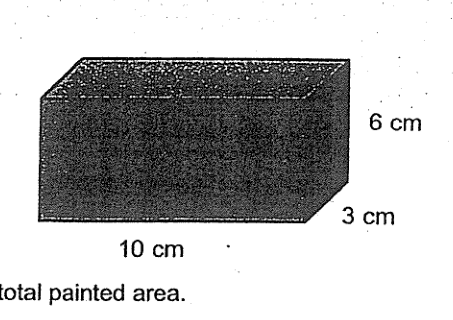
- (a)
Calculate the total painted area.
- (b)
Freddy wants to cut the largest possible cube from the rectangular block. What is the greatest number of such cubes he can cut from the rectangular block?
It won't just hand you the answer — it asks where you're stuck.How the checker works
Worked solution
13(a)
1. Identify the dimensions of the rectangular block
Length () =
Width () =
Height () =
2. Calculate the area of the three distinct pairs of faces
Area of top and bottom faces =
Area of front and back faces =
Area of left and right faces =
3. Sum the areas to find the total painted area
Total surface area =
13(b)
1. Determine the side length of the largest possible cube that can be cut from the block.
The dimensions of the block are , , and .
The largest possible cube must have a side length equal to the smallest dimension of the block, which is .
2. Calculate the number of $3\text{ cm}$ cubes that can fit along each dimension and find the total number.
Number of cubes along the length (): with a remainder of . So, cubes.
Number of cubes along the width (): cube.
Number of cubes along the height (): cubes.
Total number of cubes .
AI analysis — may contain mistakes.
Worked this one out on paper? Snap your steps and Gigle's AI math checker will circle the step where it went wrong.