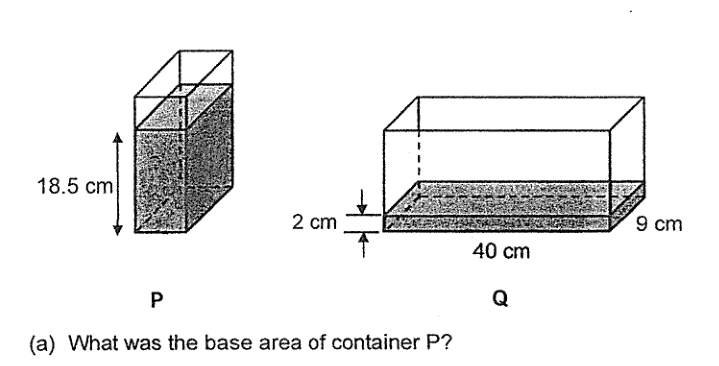
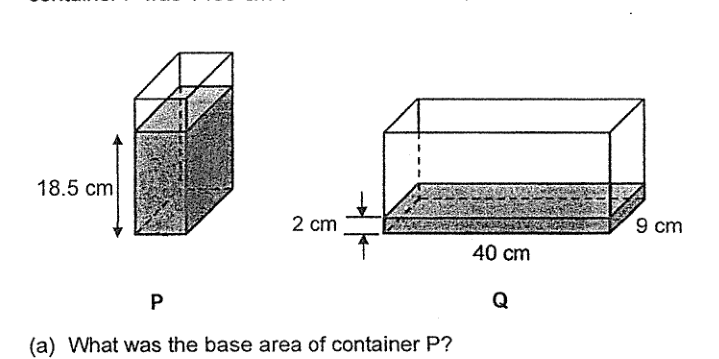
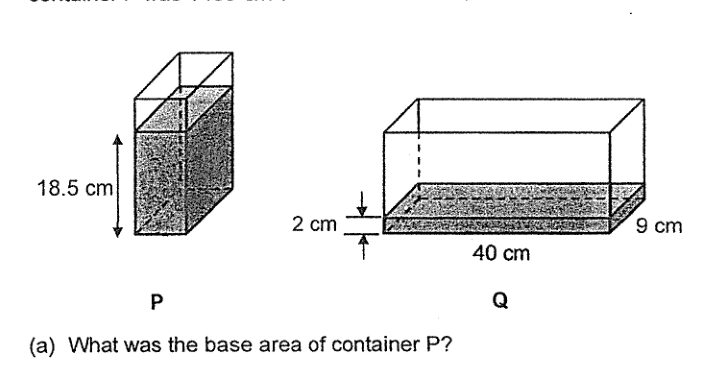
P and Q are two rectangular containers. At first container P contained water to the height of 18.5 cm while that of container Q was 2 cm. The volume of water in container P was 1480 cm^3.
- (a)
What was the base area of container P?
Ans: (a) ___
- (b)
Vera poured some water from container P into container Q without spilling. After that, the height of the water level of container P was the same as that of container Q. What was the new height of the water level in container Q?
Ans: (b) ___
It won't just hand you the answer — it asks where you're stuck.How the checker works
Worked solution
15(a)
1. Calculate the base area of container P using its volume and height
15(b)
1. Find the base area of container P (from part a)
Base area of P
2. Find the base area of container Q
Base area of Q
3. Find the total volume of water in both containers
Initial volume in Q
Total volume
4. Find the new common height
Total base area
New height
cm
AI analysis — may contain mistakes.
Worked this one out on paper? Snap your steps and Gigle's AI math checker will circle the step where it went wrong.