A civil engineer is designing a bridge which is 131 metres long, 40 metres high and is to have four identical parabolic arches along its length. Each arch is 34 metres high and there is one metre between bases of each adjacent pair of arches as shown in the diagram. A set of axes is placed with the origin at the left-hand end of the base of the first arch.
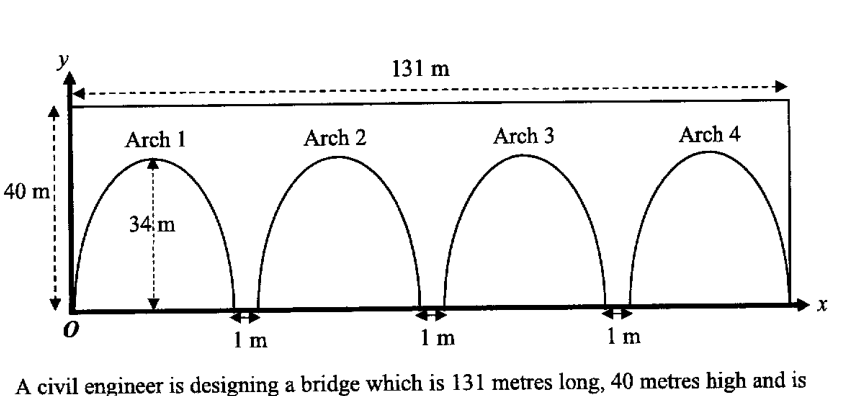
- (a)
Find the -intercepts of Arch 1.
- (b)
The equation representing Arch 1 can be written in the form . Show that .
- (c)
Explain, with working, if the point lies on Arch 2.
It won't just hand you the answer — it asks where you're stuck.How the checker works
Worked solution
8(a)
1. Find the width of a single arch
Let be the width of one arch.
The total length of the bridge consists of 4 arches and 3 gaps of 1 m each.
2. Determine the $x$-intercepts of Arch 1
Since Arch 1 starts at the origin () and has a width of m, its -intercepts are at and .
and
8(b)
1. Substitute the $x$-intercepts of Arch 1 into the factored form of the quadratic equation.
From part (a), the -intercepts of Arch 1 are and .
Thus, and .
The equation is .
2. Use the maximum height of the arch to find the value of $a$.
The maximum height occurs at the midpoint of the -intercepts, which is .
The height of the arch is m, so the vertex is at .
Substitute and into the equation:
(shown)
Shown that .
8(c)
1. Determine the $x$-intercepts of Arch 1 from the context
Let the width of each arch be . There are 4 arches and 3 gaps of 1 m each.
The -intercepts of Arch 1 are and .
2. Determine the $x$-intercepts of Arch 2
Arch 2 starts after Arch 1 and a 1 m gap.
Start of Arch 2:
End of Arch 2:
The -intercepts of Arch 2 are and .
3. Form the equation of Arch 2
Since the arches are identical, the value of is the same as Arch 1, .
The equation of Arch 2 is .
4. Check if the point $(50, 30)$ satisfies the equation of Arch 2
Substitute into the equation of Arch 2:
Since , the point does not lie on Arch 2.
No, the point does not lie on Arch 2.
AI analysis — may contain mistakes.
Worked this one out on paper? Snap your steps and Gigle's AI math checker will circle the step where it went wrong.